


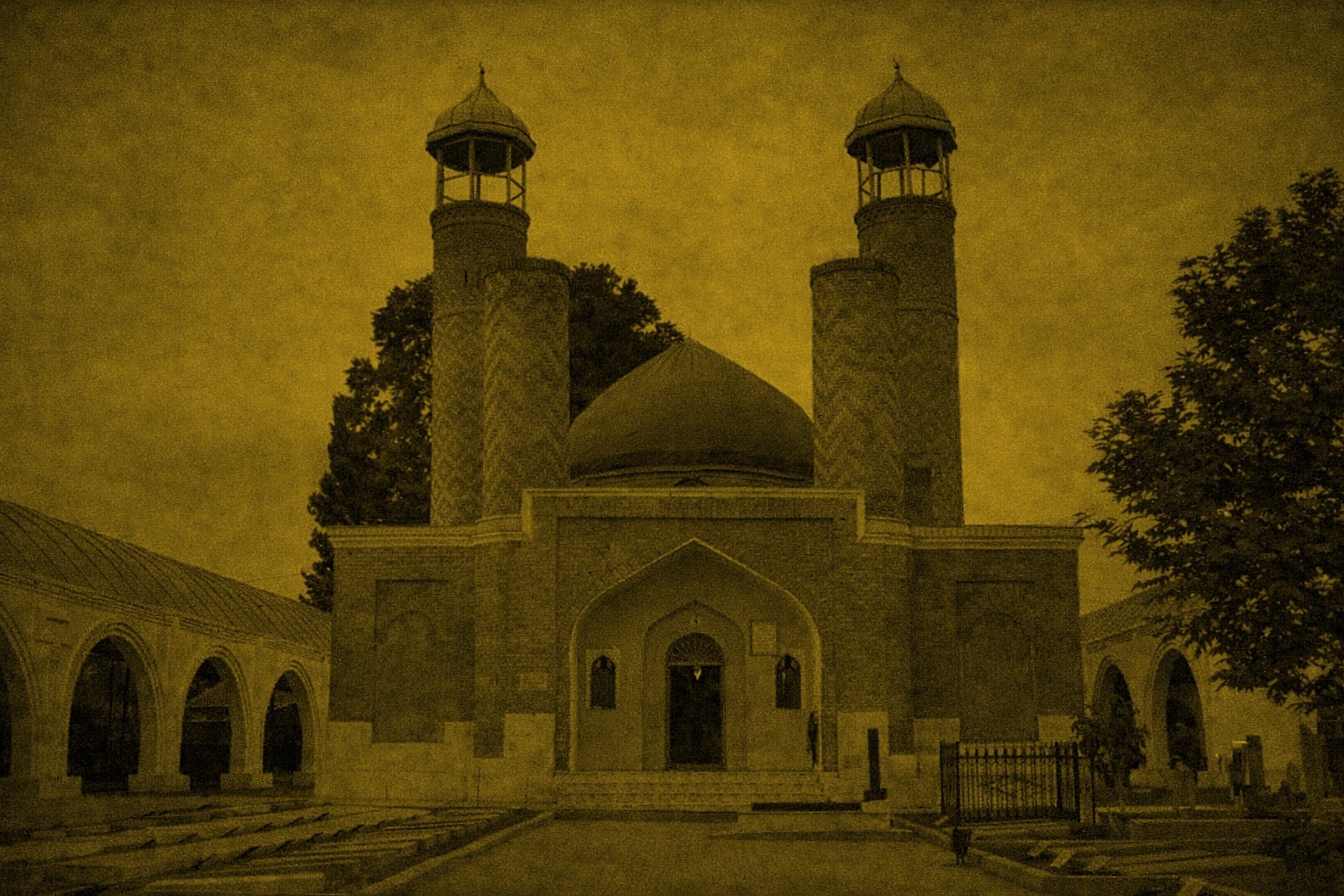
It is narrated that Imamzadeh Ismail, the son of Imam Muhammad al-Baqir (peace be upon him) and the brother of Prince Ibrahim, is buried here. According to popular belief, they came to Azerbaijan together and sought refuge from the ruler of Barda. Shortly afterward, the agents of the caliph learned of their presence and, without the permission of the local ruler, killed Imamzadeh Ismail. His brother, Imamzadeh Ibrahim, then fled to Ganja.¹
The Barda Imamzadeh is located within a spacious courtyard. The mausoleum, crowned with an onion-shaped dome, has four minarets—two of them are 12 meters high, while the other two reach 15 meters. The shrine was originally built in the 14th century and was expanded and improved in the 19th century by the architect Karbalayi Safikhan Karabakhi.²
The Barda Imamzadeh is also mentioned in A.A. Bakikhanov’s book “Gulistan-i Iram.” In 1860, it was studied by the Russian orientalist academician B. Dorn. The “Caucasian Calendar” published in 1886 states:
“Imamzadeh — a mausoleum (pir) in the village of Barda, Javanshir district of the Elisabethpol Governorate. In 1868, a mosque was built over the mausoleum.”
Sources
- ¹ Azerbaijan: The Pearl of Islamic Culture, pp. 172–173
- A.V. Salamzadeh, Architecture of Azerbaijan in the 16th–19th Centuries, pp. 31–32
- ² Caucasian Calendar, 1886, p. 158