


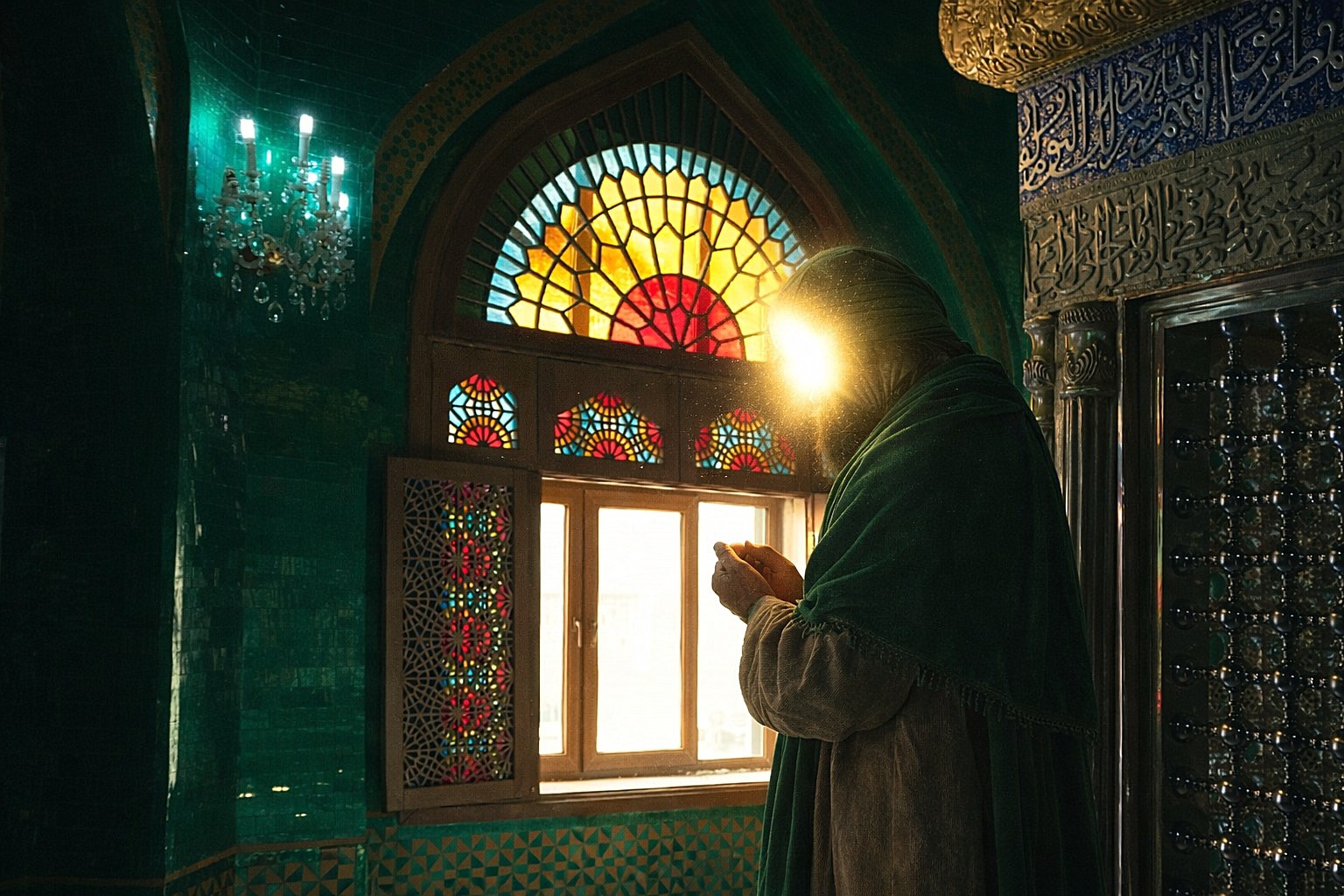
The ninth Imam, Imam Muhammad al-Taqi (peace be upon him), was the son of the eighth Imam, Imam Ali al-Rida (peace be upon him). His mother was a bondwoman named Khayzuran, who was from the lineage of the relatives of Maria al-Qibtiyya, the wife of the Prophet Muhammad (peace and blessings be upon him and his family). Her original name was Subayka, but Imam al-Rida changed it to Khayzuran. Imam Muhammad al-Taqi (peace be upon him) was born in Medina on the 10th of Rajab in the year 195 AH, or according to another narration, in the month of Ramadan of the same year (811 CE). His paternal aunt, Hakima Khatun, was present at his birth, and narrations from her regarding this event will be presented in the following pages. Among the most well-known titles of the Imam are “al-Taqi” (the pious) and “al-Jawad” (the generous).
Imam Muhammad al-Taqi (peace be upon him), with the exception of Imam al-Mahdi (peace be upon him), assumed the Imamate at the youngest age among the Imams. When his father, Imam al-Rida (peace be upon him), passed away in Khurasan, he had not yet reached the age of eight. Nevertheless, Imam al-Taqi (peace be upon him) surpassed the greatest scholars of his time in knowledge, morality, and intelligence. After the martyrdom of Imam al-Rida (peace be upon him), those who initially objected to his succession due to his young age soon realized their mistake after engaging in discussions with him.
In order to strengthen his control over Imam Muhammad al-Taqi (peace be upon him), the Abbasid caliph al-Ma’mun summoned him to Baghdad. The caliph attempted to diminish the Imam’s influence by encouraging court scholars and other learned men to ask him difficult questions, hoping that he would be unable to answer and thus be disgraced. However, the Imam emerged victorious from all scholarly debates.
In such circumstances, al-Ma’mun decided to implement a plan that he had previously attempted, unsuccessfully, with Imam al-Rida (peace be upon him). This time, he married his daughter Umm al-Fadl to Imam Muhammad al-Taqi (peace be upon him). His intention was to strengthen his own rule by declaring their future child as his successor. Since this child would be recognized as a descendant of the Ahl al-Bayt, people would accept his authority, and al-Ma’mun could effectively rule in his name. However, no child was born from this marriage.
After some time, the Imam returned from Khurasan to Medina. Following the death of al-Ma’mun, his brother and successor al-Mu‘tasim summoned the Imam to Baghdad in 220 AH (835 CE). In Baghdad, all scholarly debates arranged with court scholars once again ended in favor of Imam al-Taqi (peace be upon him). Concerned about the Imam’s growing influence, al-Mu‘tasim ordered that he be poisoned. Imam Muhammad al-Taqi (peace be upon him) passed away in Baghdad as a result of this poisoning on the last day of the month of Dhu al-Qa‘dah in 220 AH (835 CE). He was buried in the Quraysh cemetery next to the grave of his grandfather, Imam Musa al-Kazim (peace be upon him). Today, this place is known as al-Kazimiyya (Kazimayn), where a mausoleum complex with twin domes and four minarets stands over the graves of both Imams.
Despite his short life—he lived only 25 years—and the difficult circumstances of his time, Imam Muhammad al-Taqi (peace be upon him) succeeded in educating many distinguished students. Among those who studied under him and transmitted his traditions were Ahmad ibn Muhammad al-Bazanti, Fadl ibn Shadhan, Muhammad ibn Abi ‘Umayr, ‘Ali ibn Mahziyar, Zakariyya ibn Adam, and others.
Sources
The sections related to Imam al-Kazim (peace be upon him), Imam al-Rida (peace be upon him), and Imam al-Taqi (peace be upon him) are mainly based on the following sources:
Da’irat al-Ma‘arif al-Tashayyu‘ (prepared under the supervision of A.S. Haji Seyyed Javadi, K. Fani, and B. Khorramshahi), Vol. 2
Shaykh Abbas Qummi, Muntaha al-Amal, Vol. 2
Baqir Sharif al-Qarashi, Mawsu‘at Sirat Ahl al-Bayt, Vols. 30–32
Mawsu‘at al-Imam al-Kazim and Mawsu‘at al-Imam al-Rida (prepared under the leadership of Sayyid Muhammad Husayni Qazwini)
Ja‘far Murtada al-Amili, al-Hayat al-Siyasiyya li al-Imam al-Rida
Short Islamic Encyclopedia (edited by N. Rahimov), Vol. 2