


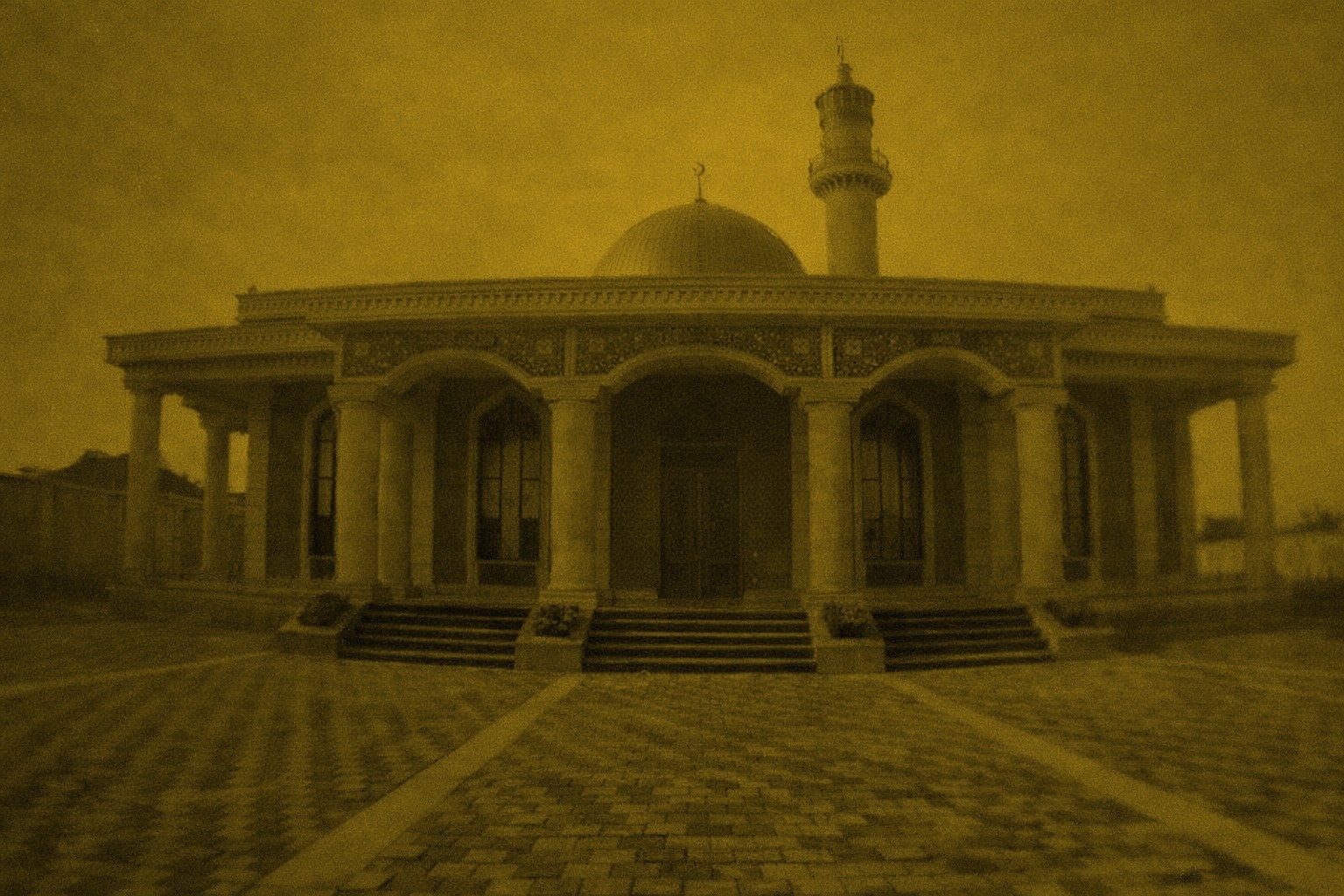
This architectural monument, located in the southeastern part of the city of Nakhchivan, dates back to the first half of the 18th century—the late period of the Safavid state—and was built in the style of the Nakhchivan-Maragha architectural tradition. The core of the complex is the mausoleum. The structure, which has a square plan at the base, features a cylindrical main body, with the transition to the dome achieved through stalactite (muqarnas) elements. On the exterior walls of the mausoleum, the architect skillfully created a repeatedly inscribed epigraphic motif of the word “Allah” using red and dark purple bricks. This decorative style had previously been used in the Sheikh Safi mausoleum in Ardabil.
Inside the mausoleum, there is a sarcophagus-type grave measuring 150 cm in length, 88 cm in height, and 115 cm in width. According to popular belief, this grave belongs to the son of the eighth Imam, Imam al-Rida (peace be upon him).
Adjacent to the main building containing the grave, there is a large rectangular hall, followed by a more spacious prayer hall covered with a large dome. Historically, the khans of Nakhchivan and members of their lineage were buried here.
An inscription written in Naskh script once existed on the northwestern wall of the mausoleum. According to studies conducted in the 1920s, the mausoleum was built during the reign of the Safavid ruler Shah Tahmasib II (1722–1732) by order of Hazrat Rufai Bey, the son of Haji Fulad Bey.
Graves dating back to the 17th century and later periods are located around the Imamzadeh complex. The complex underwent major restoration in 2008.*
- Salamzadeh A.V., Architecture of Azerbaijan in the 16th–19th Centuries, pp. 58–59
- A.V. Salamzadeh, K.M. Mammadzadeh, Monuments of the Nakhchivan Architectural School of Azerbaijan, p. 191
- V. Bakhshaliyev, F. Guliyeva, Historical Monuments of Nakhchivan, pp. 189–191